Why Japanese Matters in tax treatment — Trade Buyer Briefing
VapeWholesaleHub Japanese · Japanese wholesale supply
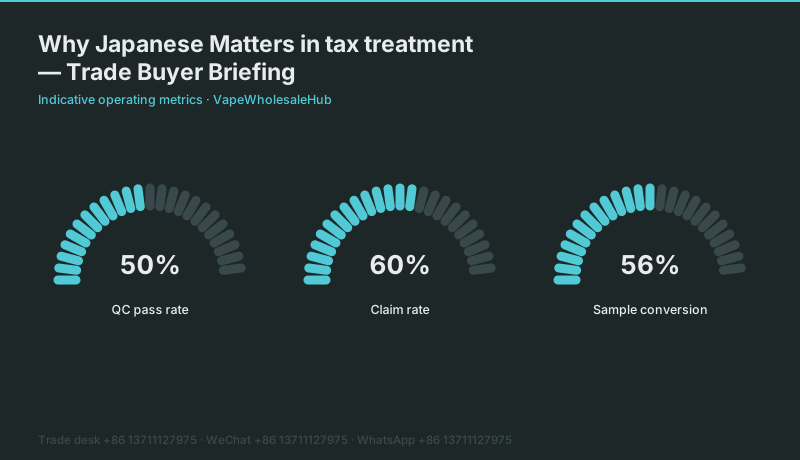
Buyers tend to discover the real cost of why Japanese Matters in tax treatment — Trade Buyer Briefing only after the first full quarter. That is usually when the pattern becomes visible: which lines turn quickly, which ones sit, and which supplier answers the phone. This page sets out the practical checks that make that first quarter cheaper.
Freight, packaging and landed cost
Freight for why Japanese Matters in tax treatment — Trade Buyer Briefing has its own rhythm. Peak season rates, holiday closures and carrier capacity all move the landed cost in ways that a unit price sheet never shows. We plan replenishment backwards from the shelf date rather than forwards from the order date, and it removes most of the surprises.
Logistics decides whether why Japanese Matters in tax treatment — Trade Buyer Briefing is profitable more often than product quality does. A three day saving on a freight route is worth more per unit than most price negotiations, and it is usually easier to achieve. Mode choice, consolidation and customs pre-clearance are where the margin actually lives.
What quality control looks like in practice
A quality system for why Japanese Matters in tax treatment — Trade Buyer Briefing should produce a number someone is accountable for. Defect rate per batch, days to resolution, repeat complaint rate. Without a number, quality becomes an opinion, and opinions do not survive a busy quarter.
The failure modes in why Japanese Matters in tax treatment — Trade Buyer Briefing are predictable once you have seen enough of them. Seals that relax in heat, tolerances that drift after a tooling change, inputs that separate in transit. Testing for the known failure modes catches roughly ninety percent of what would otherwise reach a customer.
Technical detail worth understanding
The engineering around why Japanese Matters in tax treatment — Trade Buyer Briefing is mostly about managing heat and airflow. Change either and the whole experience moves. Buyers who understand that relationship can read a spec sheet properly and spot the marketing numbers that do not survive contact with a customer.
Specification drift is the quiet risk in why Japanese Matters in tax treatment — Trade Buyer Briefing. A unit approved in January is not necessarily the unit shipped in September unless the change control is tight. We document every revision, and we tell accounts before the change rather than after someone notices.
Documentation and regulatory reality
The compliance burden around why Japanese Matters in tax treatment — Trade Buyer Briefing is mostly about being boring and consistent. Keep one version of the truth for every SKU, stamp the revision date, and make sure the file a regulator sees is the same one your warehouse picks from. Most enforcement cases we have watched started with a mismatch between two internal documents.
Compliance is where why Japanese Matters in tax treatment — Trade Buyer Briefing either holds together or quietly falls apart. Regulators are not interested in intent; they want documents that match the physical goods. If the label says one thing and the test report says another, the shipment is the problem, not the paperwork.
Order structure at a glance
| Item | Standard | Volume | Programme |
|---|---|---|---|
| Typical order unit | Master carton | Pallet | Full container |
| Documentation | COA + SDS | COA + SDS + batch record | Full technical file |
| Lead time | 2-4 working days | 5-10 working days | 15-25 working days |
| Customisation | Label only | Label + closure + bottle | Full OEM / ODM |
| Sampling | Charged, credited on order | Included in development | Multi-round approval |
| Indicative MOQ | 600 units | 3,000 units | 12,000 units |
| Development window | n/a | 7-12 working days | 7-12 + approval |
Common questions
How long does a bulk order take to arrive?
Stock lines usually leave the warehouse within two to four working days, with transit depending on the mode you choose. Custom development runs on a longer clock: formulation, approval, production and testing before anything ships. We give a written schedule at order confirmation and flag slippage the day we see it.
Can you supply documentation for our regulator?
Yes. Technical files, certificates of analysis, safety data sheets and batch records are provided with shipments on request. Tell us which national scheme you operate under at the enquiry stage and we will confirm exactly which documents come as standard.
What shelf life should we plan around?
Unopened e-liquid is typically stable for around two years when stored cool and away from direct light, and device batteries lose capacity on a similar curve. We print manufacture dates and batch codes on every unit so stock rotation is straightforward.
Related reading
- Japanese Vape Supply Notes 827
- Japanese: Balancing Price Against last mile delivery — Scaling Up
- Lead Times and tax treatment for Japanese Orders — Cash and Carry Notes
- Japanese Vape Supply Notes 505
- Japanese Vape Supply Notes 1240
- Japanese in the Wholesale Chain: A Practical Overview — New Account Setup
Talk to the wholesale desk. Specifications, MOQ, stock and freight options for why Japanese Matters in tax treatment — Trade Buyer Briefing.
Phone +86 13711127975 · WeChat +86 13711127975 · WhatsApp +86 13711127975