Comparing Japanese Approaches Across Markets — Bulk Order Planning
VapeWholesaleHub Japanese · Japanese wholesale supply
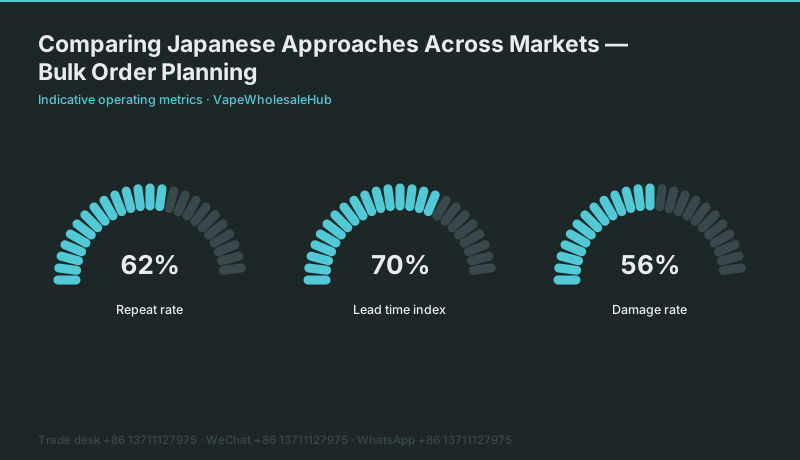
There is a version of comparing Japanese Approaches Across Markets — Bulk Order Planning that exists in supplier decks, and there is the version that shows up on a warehouse floor at 7am when a shipment is short by two cartons. We spend our time in the second version. Below is what we have learned handling comparing Japanese Approaches Across Markets — Bulk Order Planning for wholesale accounts.
Documentation and regulatory reality
Compliance is where comparing Japanese Approaches Across Markets — Bulk Order Planning either holds together or quietly falls apart. Regulators are not interested in intent; they want documents that match the physical goods. If the label says one thing and the test report says another, the shipment is the problem, not the paperwork.
The compliance burden around comparing Japanese Approaches Across Markets — Bulk Order Planning is mostly about being boring and consistent. Keep one version of the truth for every SKU, stamp the revision date, and make sure the file a regulator sees is the same one your warehouse picks from. Most enforcement cases we have watched started with a mismatch between two internal documents.
What quality control looks like in practice
Quality control on comparing Japanese Approaches Across Markets — Bulk Order Planning is unglamorous and repetitive, which is exactly why it works. Incoming inspection, fill weight checks, leak testing and a retained sample from every batch. None of this is clever; all of it is cheaper than a recall.
A quality system for comparing Japanese Approaches Across Markets — Bulk Order Planning should produce a number someone is accountable for. Defect rate per batch, days to resolution, repeat complaint rate. Without a number, quality becomes an opinion, and opinions do not survive a busy quarter.
Freight, packaging and landed cost
Packaging is part of logistics, not marketing. Cartons for comparing Japanese Approaches Across Markets — Bulk Order Planning need to survive stacking, humidity and a forklift operator having a bad Monday. We specify board grade and pallet pattern before we talk about print finish, because a damaged pallet costs more than any artwork upgrade recovers.
Freight for comparing Japanese Approaches Across Markets — Bulk Order Planning has its own rhythm. Peak season rates, holiday closures and carrier capacity all move the landed cost in ways that a unit price sheet never shows. We plan replenishment backwards from the shelf date rather than forwards from the order date, and it removes most of the surprises.
The commercial side of the decision
Commercially, comparing Japanese Approaches Across Markets — Bulk Order Planning rewards buyers who think in turns rather than in unit cost. A slightly higher price on a line that sells through twice as fast is better money than a cheap line that occupies shelf space and working capital for two seasons.
Margin on comparing Japanese Approaches Across Markets — Bulk Order Planning is usually set by the structure of the deal, not the sticker. Payment terms, freight responsibility, breakage allowance and return rights all move the real number. We would rather agree a clean structure with a fair price than a low price with vague terms that get argued about later.
Order structure at a glance
| Item | Standard | Volume | Programme |
|---|---|---|---|
| Typical order unit | Master carton | Pallet | Full container |
| Documentation | COA + SDS | COA + SDS + batch record | Full technical file |
| Lead time | 2-4 working days | 5-10 working days | 15-25 working days |
| Customisation | Label only | Label + closure + bottle | Full OEM / ODM |
| Sampling | Charged, credited on order | Included in development | Multi-round approval |
| Indicative MOQ | 300 units | 1,500 units | 6,000 units |
| Development window | n/a | 3-5 working days | 3-5 + approval |
Common questions
What is the usual minimum order quantity?
Minimum order quantity depends on the line. Standard stock items typically start at a single master carton, while custom work, private label artwork and bespoke tooling carry higher thresholds because the setup cost has to be recovered. We publish the figure for each line rather than quoting one blanket number.
What happens if goods arrive damaged?
Photograph the cartons before unpacking, keep the packaging, and send the batch code with your claim. We settle legitimate freight damage as a credit or replacement on the following order rather than leaving it open for months.
Which payment methods do you accept?
We accept bank wire transfer for most wholesale accounts, with card and digital payment options available for samples and smaller orders. Established accounts can apply for credit terms after a trading history has been established.
Related reading
- Understanding warehousing in Japanese Wholesale — Scaling Up
- Japanese Vape Supply Notes 559
- Understanding carrier networks in Japanese Wholesale — Contract Supply Guide
- How Japanese Programmes Affect Your warehousing — High Volume Planning
- Japanese and last mile delivery in Contract Supply — Franchise Network Guide
- Japanese: Balancing Price Against import duties — Distributor Focus
Talk to the wholesale desk. Specifications, MOQ, stock and freight options for comparing Japanese Approaches Across Markets — Bulk Order Planning.
Phone +86 13711127975 · WeChat +86 13711127975 · WhatsApp +86 13711127975